What Are Actions, Scripts, Plugins, and Extensions in Adobe Illustrator?
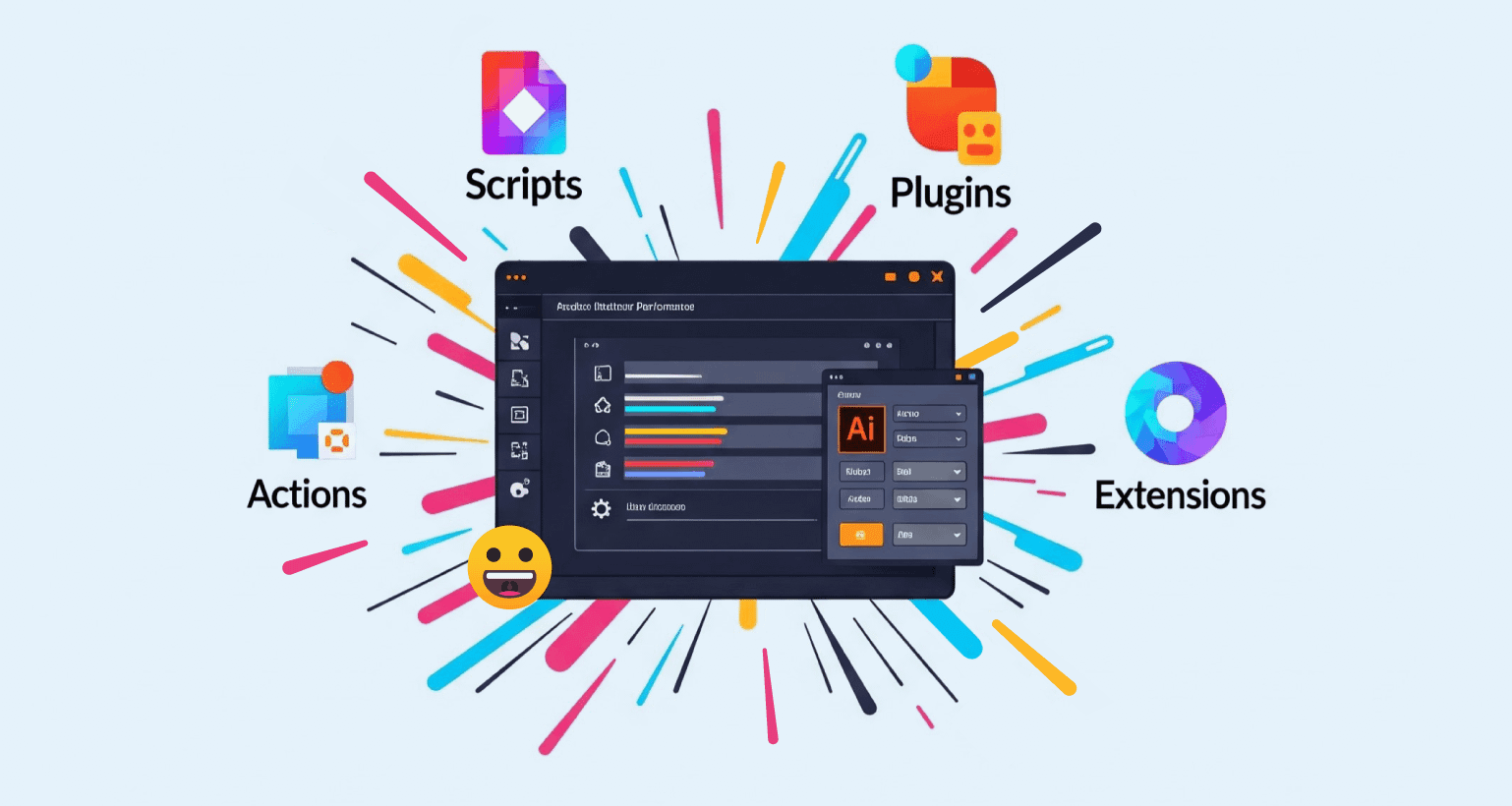
When working in Adobe Illustrator, designers often come across various tools that enhance functionality, such as Actions, Scripts, Plugins, and Extensions.
Although all of these tools are designed to improve productivity and expand Illustrator’s capabilities, they differ in how they work and when they are best used. Understanding these differences helps you choose the right tool for your needs and create a smoother, more efficient design workflow.
Four Types of Illustrator Extension Technologies and Hybrid Applications
In Adobe Illustrator, different types of extension tools can be seen as solutions designed for specific needs. In addition to the common formats, some tools combine multiple technologies to create what are known as “hybrid” extensions, integrating various functions and use cases into a single workflow.
🔹Actions: Streamlining Repetitive Tasks
Actions are a built-in automation feature in Illustrator that allows users to record a sequence of steps and replay them whenever needed. Whether adjusting colors, applying effects, or managing layers, almost any workflow that can be performed manually can be recorded and automated using an Action.
How it Works:
Actions record user interactions within the Illustrator interface—such as clicks, selections, and inputs—and store them as a sequential series of steps that can be replayed with a single click.Since Actions simply "mimic" a recorded workflow, they lack the ability to perform conditional logic (e.g., executing different tasks based on an object's properties) and cannot execute custom code.
File Format:
Actions are saved as .aia files.Key Advantages:
◽Ease of Use:
No programming knowledge is required. As long as users are familiar with basic Illustrator operations, they can easily record and use Actions.
◽Quick to Create:
For simple and highly repetitive workflows, automated steps can be set up quickly.Key Limitations:
◽No Logic or Conditional Processing:
Actions cannot perform "if-then" logic, handle loops, or interact with external data. For example, an Action cannot "check" an object's properties (like color or size) and then decide to perform a different task based on what it finds.
◽Limited Flexibility:
Once an Action is recorded, modifying individual steps can be cumbersome. In addition, if the Illustrator interface changes or certain features are relocated, the Action may fail, requiring it to be re-recorded.
◽Limited Automation Capabilities:
Because Actions essentially replay manual interface operations, they offer limited performance gains over manual workflows. As a result, they are not suitable for processing large volumes of data or handling complex workflows.
💡Use Cases:
Actions are best suited for repetitive tasks with fixed workflows. Common use cases include resizing images, batch-applying visual styles, organizing layer structures, and converting file formats.
🔹Scripts: Powering Automation and Custom Workflows
Scripts are lightweight solutions used to automate operations within Illustrator.
Typically written in JavaScript or AppleScript, they interact with the application through the Scripting DOM (Document Object Model).
This enables scripts to simulate user actions and automate complex, repetitive tasks—without modifying Illustrator’s core code.
How it Works:
Scripts execute Illustrator operations based on predefined logic and instructions. Unlike Actions, scripts can incorporate conditional logic (if–then statements) and loops, enabling them to perform different tasks dynamically based on specific conditions or object properties.File Format:
The most common file extensions for JavaScript scripts are .jsx or .js. On macOS, AppleScript files typically use the .applescript or .scpt extensions.Key Advantages:
◽High Development Efficiency:
Scripting languages are relatively easy to learn and use, enabling rapid development of automated workflows. Compared to C++ plugins, development time can often be reduced by two to three times.
◽Exceptional Flexibility:
Scripts can be fully customized to fit specific workflows, such as batch typesetting, advanced object manipulation, and data processing. They also support complex conditional logic and loops.
◽Cross-Platform Compatibility:
JavaScript-based scripts (.jsx) are generally compatible with both macOS and Windows, providing a consistent experience across platforms.Key Limitations:
◽Performance Constraints:
Because scripts communicate with Illustrator through the scripting interface, their performance is generally lower than that of plugins that interact directly with the core engine. In scenarios involving large datasets or complex computations, scripts can be five to ten times slower than C++ plugins.
◽Limited Functional Scope:
Script capabilities are restricted to the APIs provided by Illustrator’s scripting interface. As a result, they cannot perform low-level operations or support fully customized rendering beyond what the API allows.
💡Use Cases:
Scripts are ideal for batch file processing, data-driven graphic generation (such as automatically generating business cards from spreadsheet data), complex object filtering and manipulation, and automated workflows that require conditional logic.
🔹Plugins: Expanding Illustrator’s Core Functionality
Plugins (also known as plug-ins or add-ons) are the most powerful way to extend Illustrator’s capabilities.
Typically developed in low-level programming languages such as C++, plugins are compiled into native machine code.
By interacting directly with Illustrator’s core engine, plugins can access and manipulate low-level graphical data and computational processes.
This enables them to deliver high-performance, deeply customized features that go far beyond standard tools.
How it Works:
Plugins are loaded into Illustrator as modules and are seamlessly integrated into the software's core architecture. This tight integration allows plugins to directly access system resources, execute complex algorithms, and process massive datasets with high efficiency.File Format:
The standard file extension for Adobe Illustrator plugins is .aip (Adobe Illustrator Plugin).Key Advantages:
◽High Performance:
Because plugins interact directly with Illustrator’s core engine, C++ plugins typically deliver significantly higher performance than scripts when handling large datasets, complex vector computations, or high-precision graphics. In demanding scenarios, this performance gap can be substantial.
◽Extensive Feature Expansion:
Plugins can implement functionality that is not available in Illustrator’s built-in toolset, allowing developers to extend or modify core behaviors.
◽High Stability:
Compiled code generally offers greater stability and is less prone to runtime errors compared to interpreted scripts.High Development Barrier:
Developing C++ plugins requires a solid foundation in programming and a deep understanding of the Illustrator SDK. As a result, the development complexity, time, and costs are typically significantly higher than those of scripts or other automation methods.
💡Use Cases:
Plugins are best suited for high-performance graphics processing, complex mathematical computations, professional file format import and export, custom rendering workflows, batch graphics optimization, and applications that require deep access to Illustrator’s core data.
🔼IllustKit is a high-performance C++ plugin for extending Illustrator.
🔹Extensions: Building Interactive Interfaces and Integrated Services
Extensions (also known as add-ons) are interface-based modules that extend Illustrator’s functionality. The most common type is the Adobe CEP (Common Extensibility Platform) panel.
These extensions are primarily built using web technologies—such as HTML5, CSS, and JavaScript—to create rich user interfaces, which communicate with Illustrator through the CEP framework.
How it Works:
At their core, extensions are web applications embedded directly into the Illustrator interface. They run as independent processes and communicate with Illustrator through the CEP (Common Extensibility Platform) framework. This framework enables extensions to send commands and receive data without directly manipulating the application’s core engine.File Format:
CEP extensions typically exist as folders containing standard web assets such as .html, .css, and .js files. They can be packaged into .zxp installers or installed directly by placing them in the system’s designated Extensions directory.Key Advantages:
◽High Interface Customization:
Leveraging web technologies allows for the creation of highly interactive and fully customizable user interfaces, providing a modern UX within Illustrator.
◽Seamless Integration with External Services:
Extensions can easily connect with web databases, cloud services, or external APIs, significantly expanding the software's functional scope through online connectivity.
◽Lower Development Barrier:
For designers or engineers already familiar with front-end development (HTML/CSS/JS), the learning curve and development costs are relatively low.Key Limitations:
◽Lower Performance:
Because extensions are built on web technologies and communicate with Illustrator through the CEP framework, their performance is generally lower than that of scripts and C++ plugins in scenarios involving large datasets or complex graphical computations.
◽Limited Access to Core Functionality:
Extensions are primarily designed for user interface development and service integration, making it difficult to perform low-level graphical processing or deeply modify Illustrator’s core functionality.
💡Use Cases:
Extensions are best suited for resource management panels, asset libraries and stock content browsers, online collaboration tools, third-party service integration interfaces, data visualization panels, and custom configuration interfaces.
🔹Hybrid Extensions: Combining Multiple Technologies
In certain scenarios, developers combine the aforementioned extension technologies to leverage their respective strengths.
Common hybrid approaches include:
CEP + C++ Plugin:
This approach separates the user interface (UI) from high-performance processing. The CEP extension provides an interactive, modern interface, while the C++ plugin handles complex or computation-intensive tasks. When a user triggers an action in the CEP panel, the corresponding commands are passed to the plugin for high-speed execution.CEP + Scripting:
This approach uses the CEP interface to launch and manage scripts. As users interact with the extension panel, Illustrator executes predefined scripts to complete automated workflows. While this improves the overall user experience and ease of use, performance remains limited by the constraints of the scripting engine.
💡Conceptual Use:
Hybrid extensions offer greater design flexibility by allowing developers to combine different technologies based on functional requirements.
For example, a CEP interface can be used to build the user interface, while scripts or plugins handle core functionality.
🔼Try a free CEP + scripting extension to get started.
Comprehensive Comparison: Choosing the Right Tool
The following table provides an overview of the key characteristics of the four extensibility methods and their hybrid approaches:
| Feature | Actions | Scripts | Plugins | Extensions | Hybrid (CEP + C++ Plugin) | Hybrid (CEP + Scripting) |
|---|---|---|---|---|---|---|
| Development Language | Recorded actions (no programming required) | Primarily JavaScript, AppleScript | Primarily C++ | HTML5, CSS, JavaScript (web technologies) | C++ (core), HTML/CSS/JS (UI) | HTML/CSS/JS (UI), JavaScript (core) |
| File Format | .aia | .jsx / .js (JS), .applescript / .scpt (AppleScript) | .aip | .zxp or folder (with .html, .css, .js) | .zxp + .aip | .zxp + .jsx / .js |
| Execution Model | Records and replays UI actions | Executes commands via scripting interface | Interacts directly with Illustrator’s core engine | Runs within CEP and communicates via APIs | CEP UI triggers C++ plugin execution | CEP UI triggers script execution |
| Performance | Low (similar to manual operations) | Moderate (typically 5–10× slower than plugins) | High (fastest; significantly outperforms scripts) | Low (optimized for UI and service integration) | High (smooth UI with high-performance processing) | Moderate (smooth UI, limited by scripting performance) |
| Capability Depth | Basic (UI-level automation only) | Automates existing features with logic support | Deep access to core functionality and data | UI layer with service integration capabilities | Strong UI + deep core functionality | Strong UI + flexible automation |
| Development Complexity | None (no coding required) | Moderate | High (significantly higher cost and complexity) | Moderate (front-end friendly) | Very High (combines multiple complex technologies) | Moderate (front-end + scripting integration) |
| User Interface | Actions panel only | No dedicated UI (background automation) | Integrated or minimal UI | Rich, interactive panels | Rich, interactive panels | Rich, interactive panels |
| Typical Use Cases | Simple repetitive tasks, batch visual adjustments | Workflow automation, batch processing, data import/export | Advanced algorithms, complex graphics processing, high-performance tasks | Asset management, service integration, custom panels | Tools requiring both high performance and rich UI | UI-driven automation tools |
For scenarios that require high-performance computation or deep functional extension within Illustrator, C++ plugins (or hybrid architectures based on them) are generally the most suitable choice.
Compared to other extensibility approaches, plugins are better suited for handling computation-intensive tasks and provide a higher level of functional extensibility.